
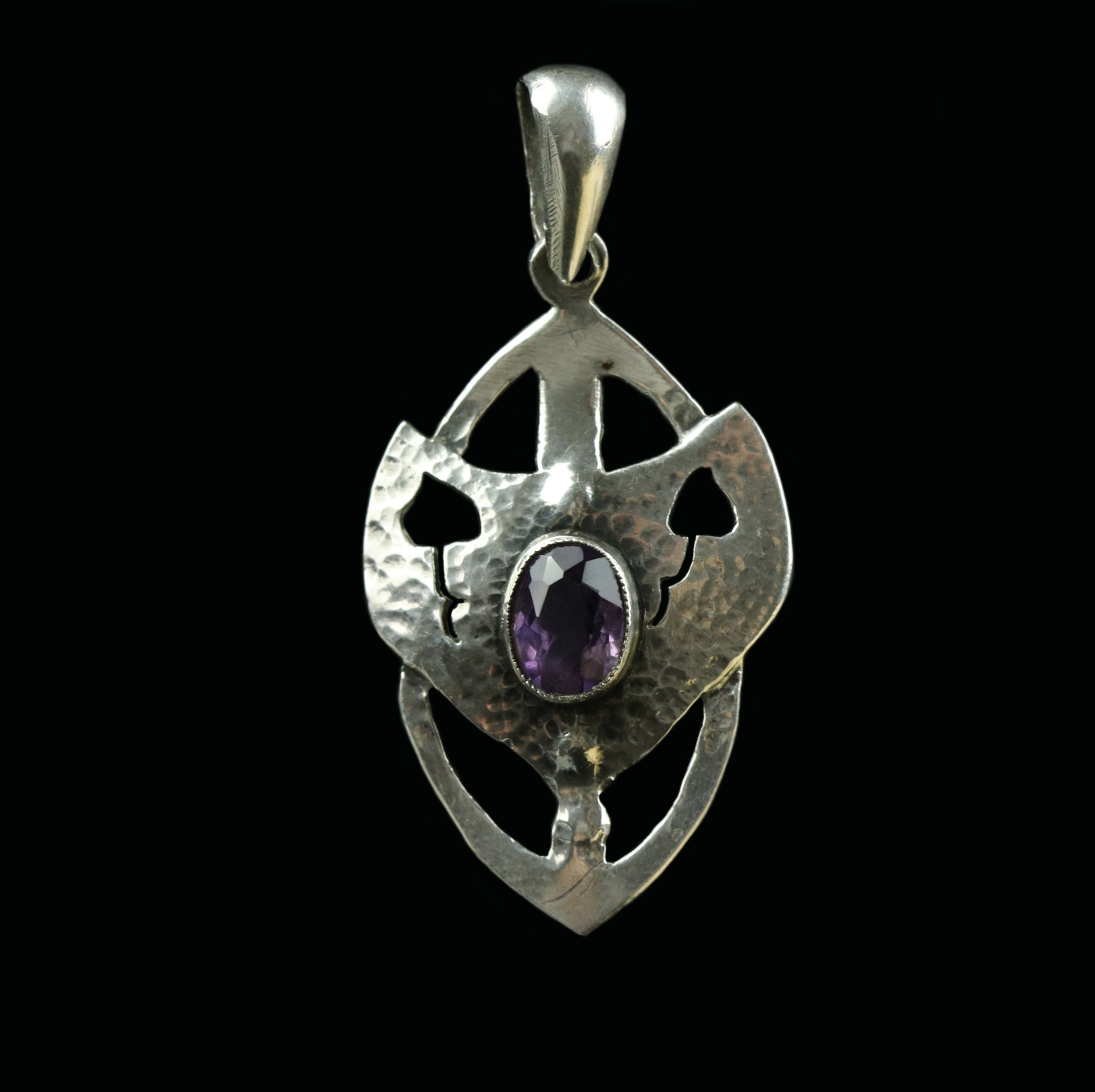
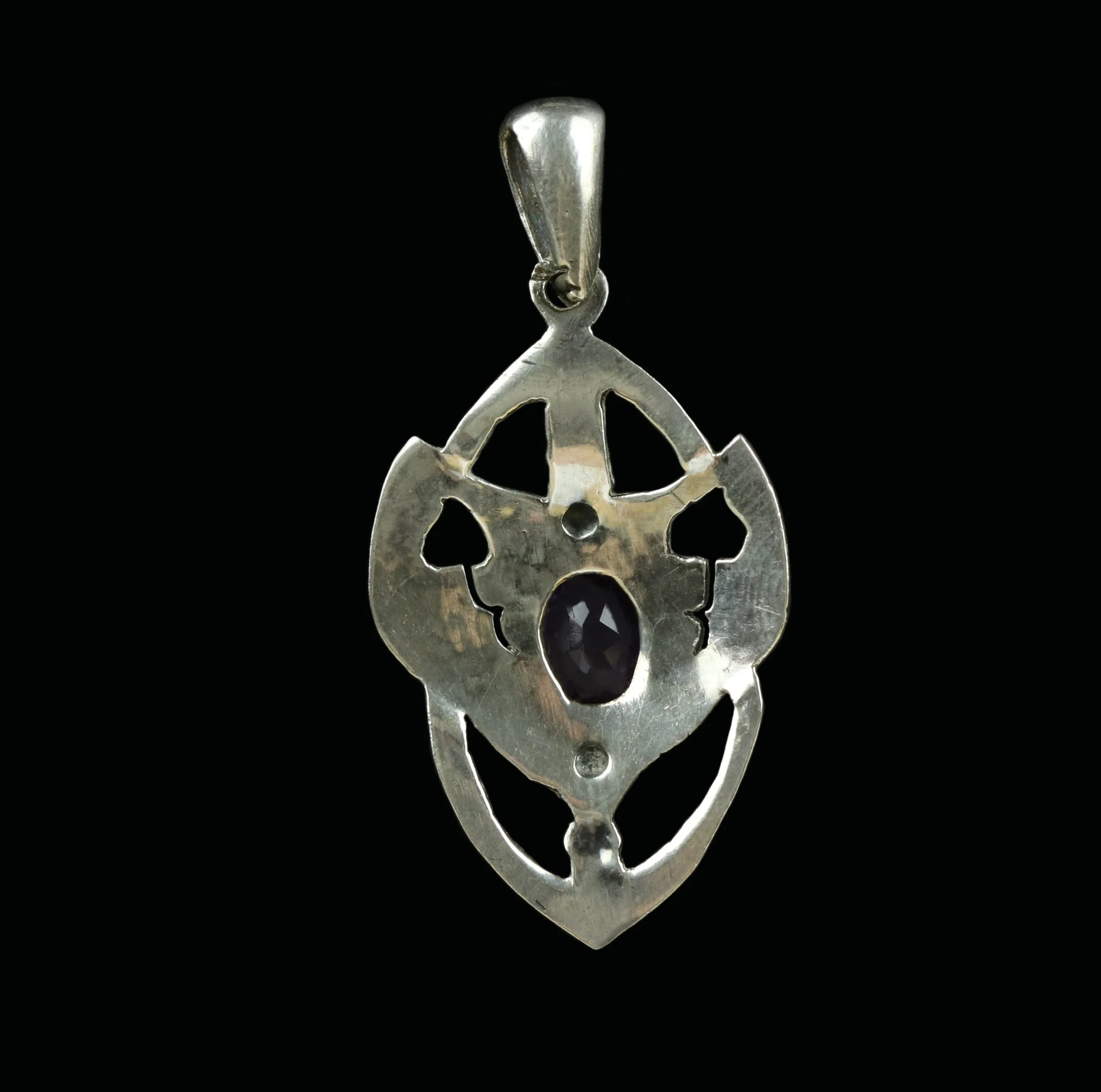
Arts & Crafts silver amethyst pendant
An Arts & Crafts silver and amethyst pendant, with pierced floral sides and hammered finish typical of the handmade ethos of the movement, in the manner of Birmingham jeweller Joseph Wray.
Amethyst has been seen as the colour of divine male sacrifice, the stone and colour typical of love, truth, passion and hope. The Hebrew name suggests the stone was believed to induce dreams and visions. The Greeks believed it to prevent inebriation. Legend goes that the maiden Amethystos refused the advances of Bacchus and prayed to the Goddess Diana to keep her chaste. To protect her, Diana transformed Amethystos into white crystal quartz. In frustration, Bacchus poured his wine over the crystals, dyeing them purple, but preventing her intoxication.The inebriation belief extends back to 320 BC to the poet Asclepiades of Samos, probably inspired by the wine-like colours of this gem. This was refuted by Pliny the Elder but why let that ruin a good time.
Amethyst has also been ascribed the birth stone for February, as such it has frequently been linked to life and love as an anonymous poem goes:
‘The February-born may find
Sincerity and peace of mind,
Freedom from passion and from care,
If she an amethyst will wear.
Let her an amethyst but cherish well,
And strife and care can never with her dwell.’
Anon.
: and due to it’s rarity in previous centuries its colour was reserved for royalty until discovery of the mines in Brazil.
Marks:
Apparently unmarked with regard to metal or maker.
Date:
Circa. 1900.
Length:
4.1cms.
Condition:
General small marks and slight discolouration in keeping with wear.
Literature:
Elyse Zorn Karlin (2004) Jewelry & Metalwork in the Arts & Crafts Tradition, Revised 2nd Edition, Schiffer.
By clicking to ‘Purchase’ you agree to having read the Important Information for Purchasers.
Our primary concern is that you are pleased with your purchase. Please feel free to ask as many questions as you like about a product before clicking purchase. We appreciate patina and the ‘age’ that older pieces acquire, because of this we do not polish pieces to strip away the age (though your local jeweller may be willing to do this for you for a small fee). Secondhand, vintage and antique pieces will naturally show scratches and small marks, these will often appear more noticeable in the enlarged images that we have made available for you. Our images are as realistic as they can be. Although any appreciable defects/damages will be mentioned please do inspect the images as they do form a part of the condition report.
Antique items may longer not be suitable for everyday wear or may benefit from thoughtful consideration when worn with care.
An Arts & Crafts silver and amethyst pendant, with pierced floral sides and hammered finish typical of the handmade ethos of the movement, in the manner of Birmingham jeweller Joseph Wray.
Amethyst has been seen as the colour of divine male sacrifice, the stone and colour typical of love, truth, passion and hope. The Hebrew name suggests the stone was believed to induce dreams and visions. The Greeks believed it to prevent inebriation. Legend goes that the maiden Amethystos refused the advances of Bacchus and prayed to the Goddess Diana to keep her chaste. To protect her, Diana transformed Amethystos into white crystal quartz. In frustration, Bacchus poured his wine over the crystals, dyeing them purple, but preventing her intoxication.The inebriation belief extends back to 320 BC to the poet Asclepiades of Samos, probably inspired by the wine-like colours of this gem. This was refuted by Pliny the Elder but why let that ruin a good time.
Amethyst has also been ascribed the birth stone for February, as such it has frequently been linked to life and love as an anonymous poem goes:
‘The February-born may find
Sincerity and peace of mind,
Freedom from passion and from care,
If she an amethyst will wear.
Let her an amethyst but cherish well,
And strife and care can never with her dwell.’
Anon.
: and due to it’s rarity in previous centuries its colour was reserved for royalty until discovery of the mines in Brazil.
Marks:
Apparently unmarked with regard to metal or maker.
Date:
Circa. 1900.
Length:
4.1cms.
Condition:
General small marks and slight discolouration in keeping with wear.
Literature:
Elyse Zorn Karlin (2004) Jewelry & Metalwork in the Arts & Crafts Tradition, Revised 2nd Edition, Schiffer.
By clicking to ‘Purchase’ you agree to having read the Important Information for Purchasers.
Our primary concern is that you are pleased with your purchase. Please feel free to ask as many questions as you like about a product before clicking purchase. We appreciate patina and the ‘age’ that older pieces acquire, because of this we do not polish pieces to strip away the age (though your local jeweller may be willing to do this for you for a small fee). Secondhand, vintage and antique pieces will naturally show scratches and small marks, these will often appear more noticeable in the enlarged images that we have made available for you. Our images are as realistic as they can be. Although any appreciable defects/damages will be mentioned please do inspect the images as they do form a part of the condition report.
Antique items may longer not be suitable for everyday wear or may benefit from thoughtful consideration when worn with care.