
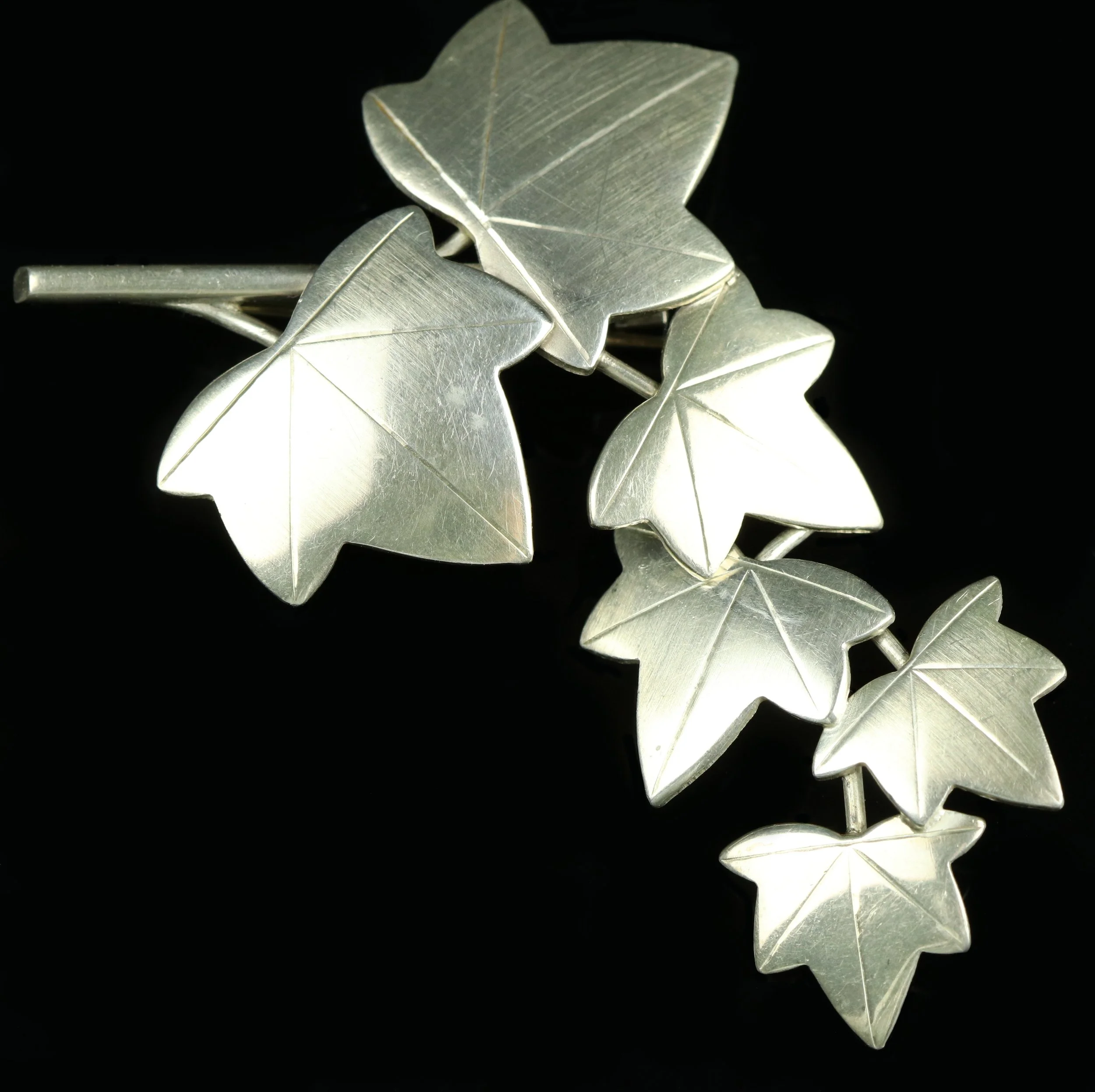
1960s silver ivy brooch, by Geoffrey Bellamy for Ivan Tarratt.
Ivan Tarratt worked with top designers to create an in-house jewellery collection. One of their chief designers was Geoffrey Bellamy. An RAF pilot in the Second World War, he later trained at the Birmingham College of Art and then the Royal College of Art in London under Robert Godden. His style was heavily influenced, as were many others of the time, by the Scandinavian design ethos of nature, simplicity and clean lines.
Ivy was in high esteem among the previous civilisations. Its leaves formed the wreath of Bacchus, to whom the plant was dedicated, possibly because of the practice of binding the brow with Ivy leaves to prevent intoxication. We are told by old writers that the effects of intoxication by wine are removed if a handful of Ivy leaves are bruised and gently boiled in wine and drunk. Ivy was also said to grow abundantly over the mythical mountain of Nysa where Bacchus (Dionysus) grew up.
In the language of flowers Ivy stands for fidelity in marriage, it’s clinging nature makes it a symbol of love and friendship.
It could also be a perfect gift for that Ivy League university acceptance.
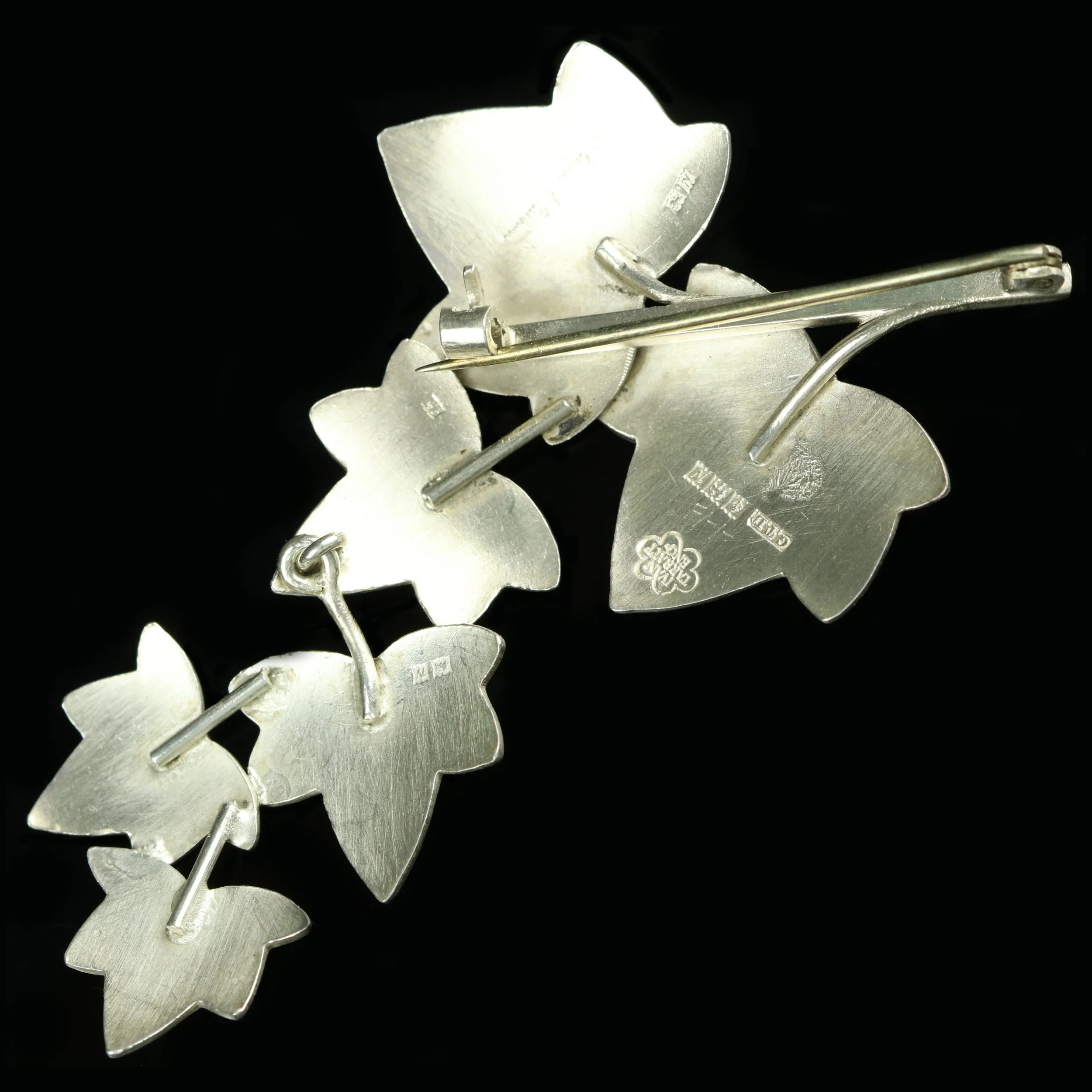
Marks:
Hallmarks for Birmingham, 1962.
Geoffrey Bellamy facsimile signature.
Ivan Tarratt maker’s mark.
Date:
1962.
Length:
7.8cms.
Condition:
Light surface scratches and slight discolourations/tarnish.
By clicking to ‘Purchase’ you agree to having read the Important Information for Purchasers.
Our primary concern is that you are pleased with your purchase. Please feel free to ask as many questions as you like about a product before clicking purchase. We appreciate patina and the ‘age’ that older pieces acquire, because of this we do not polish pieces to strip away the age (though your local jeweller may be willing to do this for you for a small fee). Secondhand, vintage and antique pieces will naturally show scratches and small marks, these will often appear more noticeable in the enlarged images that we have made available for you. Our images are as realistic as they can be. Although any appreciable defects/damages will be mentioned please do inspect the images as they do form a part of the condition report.
Antique items may longer not be suitable for everyday wear or may benefit from thoughtful consideration when worn with care.
1960s silver ivy brooch, by Geoffrey Bellamy for Ivan Tarratt.
Ivan Tarratt worked with top designers to create an in-house jewellery collection. One of their chief designers was Geoffrey Bellamy. An RAF pilot in the Second World War, he later trained at the Birmingham College of Art and then the Royal College of Art in London under Robert Godden. His style was heavily influenced, as were many others of the time, by the Scandinavian design ethos of nature, simplicity and clean lines.
Ivy was in high esteem among the previous civilisations. Its leaves formed the wreath of Bacchus, to whom the plant was dedicated, possibly because of the practice of binding the brow with Ivy leaves to prevent intoxication. We are told by old writers that the effects of intoxication by wine are removed if a handful of Ivy leaves are bruised and gently boiled in wine and drunk. Ivy was also said to grow abundantly over the mythical mountain of Nysa where Bacchus (Dionysus) grew up.
In the language of flowers Ivy stands for fidelity in marriage, it’s clinging nature makes it a symbol of love and friendship.
It could also be a perfect gift for that Ivy League university acceptance.
Marks:
Hallmarks for Birmingham, 1962.
Geoffrey Bellamy facsimile signature.
Ivan Tarratt maker’s mark.
Date:
1962.
Length:
7.8cms.
Condition:
Light surface scratches and slight discolourations/tarnish.
By clicking to ‘Purchase’ you agree to having read the Important Information for Purchasers.
Our primary concern is that you are pleased with your purchase. Please feel free to ask as many questions as you like about a product before clicking purchase. We appreciate patina and the ‘age’ that older pieces acquire, because of this we do not polish pieces to strip away the age (though your local jeweller may be willing to do this for you for a small fee). Secondhand, vintage and antique pieces will naturally show scratches and small marks, these will often appear more noticeable in the enlarged images that we have made available for you. Our images are as realistic as they can be. Although any appreciable defects/damages will be mentioned please do inspect the images as they do form a part of the condition report.
Antique items may longer not be suitable for everyday wear or may benefit from thoughtful consideration when worn with care.